JEDDAH, 22 January — Neil Bush, brother of US President George Bush, said here yesterday that the distorted image of the Arab world could be removed through the sustained lobbying of US politicians.
"The US media campaign against the interests of Arabs and Muslims and the American public opinion on the Israeli-Palestinian conflict could be influenced through a sustained lobbying and PR effort," Bush, chairman and chief executive officer of Ignite! Inc., said in his keynote address on the concluding day of the three-day Jeddah Economic Forum at Hilton Hotel here.
[...]
"Over 3,000 lives were lost through a brutal and horrific act that affected not only Americans but peoples all over the world. I want to express gratitude to all for their support. Without the support of the peace-loving people in this region and all over the world, the US president cannot succeed in his fight against terror," said Bush, who freely interacted with delegates before he began his speech on "The corporate challenges of human resources in a complex global environment."
Q: Fifteen of nineteen 9/11 hijackers had peace-loving Saudi passports?
A: Bomb Iraq!
Here's an interesting postscript:
Later in the day, the focus shifted to the world’s energy markets with Dr. Ray Irani, chairman and chief executive officer of Occidental Petroleum, saying that he was fundamentally opposed to the Kyoto protocol — the international agreement to place controls on the emission of greenhouse gases.
What a coincidence! In contrast with the rest of the world, the chairman and chief executive officer of Occidental Petroleum and George W. Bush are in perfect harmony on the Kyoto protocol.
Weblogs can help build "social capital" and solidarity among those whose interests are not represented in the hard right's synthesis of wealth, media, politics, and philanthropy. They call it "freedom, and justice." I call it wealth bondage, the ideology of power exercised ruthlessly from the top down, inflicted upon those who apparently love it.
Overall, the site Wealth Bondage explicitly ties the right wing's ideology, strategy and tactics to a power-lust obsessed with its own sadomasochistic fulfillment.
And if there's any doubt that this obsession is sexual, take a peek at the trembling awe of Peggy Noonan at the feet of her Superman:
[...] In the first, domestic part of the [State of the Union] speech he was serious and contained, but in the second part of the speech, on Iraq, there was a shift. His voice seemed lower and there seemed a kind of full head-heart engagement in his grave but optimistic message. For a moment I though[t] of earnest Clark Kent moving, at the moment of maximum danger, to shed his suit, tear open his shirt and reveal the big "S" on his chest.
[...]
I felt at the end of the speech not roused but moved, and it took me a while to figure out why. It was gratitude.
[...]
A steady hand on the helm in high seas, a knowledge of where we must go and why, a resolve to achieve safe harbor. More and more this presidency is feeling like a gift.
All this Lois Lane groupie-talk is difficult to stomach. But as ludicrous as the American Leni Riefenstahl can be, I have to agree with Peggy Noonan's last statement.
"Gift" is the German word for "poison" and also means "malice" or "spite." This presidency is indeed feeling very much like a poisonous dose of spite.
WASHINGTON, Jan. 30 — Laura Bush has postponed a White House symposium on the works of Emily Dickinson, Langston Hughes and Walt Whitman after some of the poets invited said they hoped to use the event to protest American military action in Iraq.
Noelia Rodriguez, the first lady's press secretary, said the event, originally planned for Feb. 12, had been designed to celebrate the written word. "While Mrs. Bush respects and believes in the right of all Americans to express their opinions," Ms. Rodriguez said today, "she, too, has opinions, and believes that it would be inappropriate to turn what is intended to be a literary event into a political forum."
The poetry symposium, planned as part of a series of White House literary events showcasing American literature, began to attract attention as an opportunity for an anti-war protest. On Sunday, Sam Hamill, a poet and founder of Copper Canyon Press in Port Townsend, Wash., sent an e-mail message to 50 friends and colleagues asking them to send him anti-war poems or statements of protest action in Iraq. Mr. Hamill, the author of 40 books of poetry, had been invited to the symposium by Mrs. Bush.
In his message, Mr. Hamill said he felt "overcome by a kind of nausea" as he read his White House invitation, and decided the only response would be to reconstitute a "Poets Against the War Movement." Mr. Hamill said that he had not planned to attend the White House event himself but that the submitted poems and statements would be compiled into an antiwar anthology to be presented to Mrs. Bush on Feb. 12.
By Wednesday, Mr. Hamill said he had received 1,500 responses, and had to create a Web site, which he named poetsagainstthewar.org, to handle the e-mail messages that were overloading his system.
Echoing inside the empty chamber of Laura's head: Those gosh-darn poets are ruining this great country of ours! You never know where the next threats to my husband's my opinions might originate. Poets should celebrate the written word — as long it agrees with my husband me. Any emails to the contrary will be dealt with.
"Noelia, get me Ashcroft on the line. After all, I have opinions too," Laura mutters. "And where's my vodka tonic."
UPDATE: The Boston Globe refreshes our memory as to how poets felt about the previous administration of Bill Clinton:
''We had an event in which President and Mrs. Clinton joined kids from Washington public schools, disabled war veterans, former poets laureate Rita Dove and Robert Hass, and we read poems by Langston Hughes and Emily Dickinson. But that was at a time when a lot of poets were happy to be supporting the president, because they thought he was being attacked unfairly.'' [former poet laureate Robert Pinsky]
Note that Langston Hughes and Emily Dickinson were two of the same poets to be feted by the cowardly Laura. Meanwhile, her husband is still struggling with the vocabulary requirements of "The Big Book of Limericks."
We are finally in a position we've fought more than a decade to reach -- a position where we can deal a death blow to the single most important source of income for radical legal groups all across the country," wrote WLF Chairman Daniel Popeo. Among the foundation's adversaries in the litigation, Popeo continues, are "groups dedicated to the homeless, to minorities, to gay and lesbian causes, and any other group that has drawn money from hard-working Americans like you and me to support its radical cause!
A death blow to the homeless! Yet another example of compassionate conservatism in action.
The topic of lawyer's trust accounts undoubtedly makes people's eyes glaze, but it contains real power to change the country. Dwight cuts through the clutter to expose the WLF's radical and hateful agenda. Thinking people, like the readers of this blog and others like it, should go read Dwight's post.
Postscript. More about the mysterious Popeo: Here's a 1988 letter from Daniel Popeo to Philip Morris, begging for $10,000 to support the WLF's continuing efforts in support of tobacco ads (scroll down).
The WLF also opposed any regulation of greenhouse gas emissions, arguing in 1999 that the "EPA has no authority under Section 202 of the Clean Air Act to regulate greenhouse gas emissions from new motor vehicles or any other source, including utilities. The Working Group also argues that even if EPA does have the authority to regulate greenhouse gas emissions, there is no sound scientific basis for doing so...." according to this press release.
Popeo is also mentioned in Sidney Blumenthal's 1986 book, The Rise of the Counter Establishment, as part of a who's who of the extreme right:
Benchmark magazine, for instance, which deals with legal issues, is published by the Center for Judicial Studies, a think tank directed by James McClellan, a former aide to New Right Senator Jesse Helms of North Carolina. The Benchmark book review editor is Gary McDowell, a Justice Department public affairs aide who has castigated the Supreme Court for making the states adhere to the constitutional stipulations on religion, speech, and other rights. Senior editor Grover Rees oversaw judicial selection at the Justice Department, and was then appointed a federal judge. Another senior editor, William Kristol, denouncer of the "judicial activists," is the special assistant to Secretary of Education William Bennett. And contributor Daniel Popeo is the head of the Washington Legal Foundation, which files briefs for New Right causes.
Google "Daniel Popeo" and see just how profoundly unfriendly this man is to his fellow citizens, the environment, and just about anything else that doesn't come on the heels of a fat corporate donation for his radical ideology.
Daniel Popeo, who so despises the homeless, is himself just a beggar.
Representative Pete Stark of California, the senior Democrat on the Ways and Means Subcommittee on Health, said: "It is clear that President Bush intends to privatize Medicare. He's cleverly using the promise of a meager drug benefit as a bribe to push Medicare beneficiaries into second-rate, low-quality health plans, putting seniors at the mercy of health maintenance organizations and the big drug companies."
Not enough can be said about the abject irresponsibility of the lies told about the "stimulus package" which preferentially benefits the wealthiest 1% US households. Nancy Pelosi's on-camera disapproval recognized that W's statement — "This tax relief is for everyone who pays income taxes" — is a lie that shows utter contempt for working people who pay taxes on wages, not dividends.
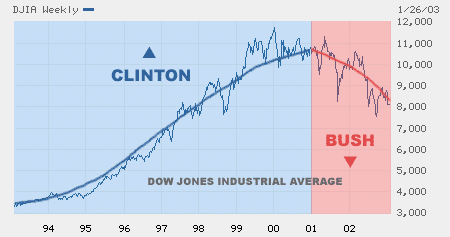
The federal deficit is out of control, thanks to the Bush enrich-the-rich giveaway. Each new forecast increases the amount of money squandered on lavish financial gifts to the wealthy, we'll-prove-it-real-soon evidence of threats from Iraq, and highly politicized Christian initiatives. From CNN:
WASHINGTON (CNN) - The Congressional Budget Office increased its forecast for U.S. government deficits of $199 billion this year and $145 billion in 2004, affirming a bleak fiscal outlook already fueling battles over taxes and spending in the run-up to the 2004 presidential election.
In August, the CBO anticipated a deficit of $145 billion in 2003 and $111 in 2004.
In a report set for release later Wednesday, the CBO also predicted the 10-year U.S. cumulative budget surplus will rise slightly to $1.3 trillion from the $1 trillion it last forecast. As recently as 2001, the CBO saw 10-year surpluses of over $5.6 trillion. A CBO spokeswoman confirmed the contents of the report to CNNfn Wednesday.
Democrats generally blame President Bush's $1.35 trillion tax cut package in 2001 for the steep slide in the U.S. fiscal position and say the $674 billion in new tax cuts he recently proposed will only dig the deficit hole deeper.
Republicans counter that tax cuts, coupled with strict government spending restraint, will help the sluggish economy grow and, ultimately, move the budget back toward balance.
In two years, a move from $5.6 trillion in surplus to $1.3 trillion in surplus. Where did the missing $4,300,000,000,000.00 go? Market ruptures and wealth disappearance due to corporate fraud by the likes of key campaign contributor Ken "Kenny Boy" Lay? Tax cuts for the families — and the heirs — of Bill Gates and George H. W. Bush? War plans? All of the above.
The compassion in W's conservatism is directed toward a small and tight-knit corporate elite, who plan to use American citizens' lives to build its wealth and secure its borders, and then burn and bulldoze their bodies into mass graves once they have served their noble purpose.
How compassionate is that?
UPDATE: The best sentence-by-sentence dissection of the entire speech was written by David Ehrenstein. (Via Roger Ailes.)
To refresh your memory, here is Toobin's overview:
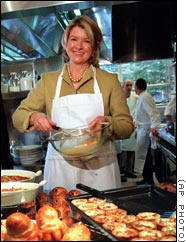
On December 26, 2001, Stewart's old friend Samuel Waksal, the chief executive of ImClone, learned that the Food and Drug Administration was going to reject the company's highly touted cancer drug, Erbitux. Knowing that the stock would plunge when this news became public, Waksal immediately tried to sell tens of thousands of shares of ImClone and encouraged his father and daughter to sell, too. For these actions, Waksal has pleaded guilty to insider trading, among other crimes, and faces as much as twelve years in prison when he is sentenced, in March. On December 27th, Stewart sold all of her stock in ImClone—3,928 shares, at fifty-eight dollars a share—grossing about two hundred and twenty-eight thousand dollars. The claim is that Stewart did so because she had an illegal tip.
Given her celebrity status as a purveyor of classy lifestyle porn, she was an easy mark and even her talk show host friends couldn't resist ripping into her during their monologues. But through the thicket of endless Martha-in-prison jokes, rays of light did shine:
Stewart looked cheerier when she recalled the support she's received—from Hillary Clinton, for one. "Look at her ups and downs," she said. "And she was one of the first people to call me after the article"—announcing the investigation—"and very nicely say, 'You know, you just have to hang in there. It's the process.' " Stewart continued, "First Lady, knocked to death and now senator. You know, a very important person, still. Because she's smart, she's worthy, she's great. You know, that's what I hope I'll be thought of as."
It's no secret that Stewart is a Democrat. It's also no secret, as Toobin writes, that the scandal has cost her in the vicinity of $400 million in stock losses as well as legal fees and lost business opportunities — the actual transaction cost of her $228,000 ImClone "insider" trade. (That she tried to sell her entire ImClone stake to Bristol-Myers two months earlier is rarely mentioned, although Toobin does.)
On the other hand, we have Thomas White, Secretary of the Army. This former Enron officer has a much clearer-cut case of insider trading than, well, just about anybody. If you want a summary of White's errors of judgment, here's a page courtesy of Sen. Barbara Boxer (D-CA). Be sure to view the highly revealing chart.
With all this information floating free of useful context, we decided to look at Martha Stewart's and Thomas White's alleged insider trades side by side, to see what we could infer about the treatment each case is receiving with respect to public discourse:
Insider Trades: US Military Leader vs. Ex-Caterer
Thomas White
Martha Stewart
Position
Secretary of the Army
CEO Martha Stewart Omnimedia
Former Position
Vice Chair Enron Energy Services
Caterer
Insider Affiliation
Enron
Imclone (via friend/CEO Waksal)
Insider Trades (Alleged)
405,710 shares
3,928 shares
Transaction Value
$12,120,827
$228,000
Number of Insider Phone Calls and Meetings
81
3
Party Affiliation
Republican
Democrat
Google Search String
"thomas white" enron
"martha stewart" imclone
Total Google Hits (1/27/03)
4,660
11,200
Smoke & Mirrors Index*
$2,601
$20
*The Smoke & Mirrors Index is Skimble's measure of ill-gotten money divided by Google hits.
If I stole $1,000 and got 10 Google hits, my Smoke & Mirrors Index would be 100, equal to $100 per Google hit. If you stole $100 and got 20 Google hits, your Smoke & Mirrors Index would be 5, or $5 per Google hit. I stole more money than you but fewer people are talking about it, so the smoke and mirrors are in my favor — distracting the world from my self-enriching crime.
Bad guys score high; (relatively) good guys score low.
In other words, the higher someone's Smoke & Mirrors Index, the more they are getting away with. The less scrutiny there is about great financial crimes, the higher the S&M Index. The more scrutiny there is about smaller crimes, the lower the S&M index.
Using the Google-based logic of the S&M Index, we see that discourse about Martha Stewart is weighted more than one hundred and thirty times over discourse about Thomas White, relative to the financial value of their alleged insider trades. Once again, disproportionate treatment of administration insiders rules the day.
Could this have anything to do with media support for an American military leader at the advent of a propagandistic war?
Could this have anything to do with keeping the stink of Enron off the administration?
Could this have anything to do with wanting to take down a strong Democratic woman?
Could this have anything to do with the general bias and/or cluelessness of the American mainstream press?
A former Dynegy trader has been indicted on federal charges of reporting bogus data to a publication that puts out a benchmark widely used to set natural gas prices.
Michelle Marie Valencia, 32, who was recently fired by Dynegy, was arrested by FBI agents this morning [1/27/03] at her Houston home.
[...]
The indictment cites three separate times -- November 2000, January 2001 and February 2001 -- that Valencia allegedly fabricated natural gas trades for submission to a trade publication called Inside FERC's Gas Market Report.
All told, the indictment alleges, she made up 43 natural gas trades. Those trades were said to have been done in the western United States, including New Mexico and California.
[...]
When she was called before U.S. Magistrate Calvin Botley, her hands were handcuffed to a thick chain that wrapped around her waist.
Outside the courtroom, Valencia's attorney, Chris Flood, said his client was the "victim of a political prosecution by the current administration trying to do something to rid itself of the stain they have from the energy industry."
Stains, stains, everywhere stains. There is an unintentional stain theme in today's posts. Go figure. More:
"Our markets are the bedrock of the U.S. economy," [U.S. Attorney Michael] Shelby said this morning.
"The market works only when there is a free flow of truthful information among its members and we intend to hold criminally accountable any person who attempts to manipulate the market by knowingly disseminating false information."
Inside FERC's is one of several publications that compile so-called indexes, which are used as benchmarks to price billions of dollars in natural gas contracts in this country.
Manipulating indexes can skew the prices consumers ultimately pay for their natural gas or electricity. But because of the energy market's complexity, it's difficult, if not impossible, to quantify potential consumer harm.
The consumer harm may be difficult, if not impossible, to quantify, but the plunder is not. One measure might be the net worths of energy markets geniuses Lay and Skilling and Fastow of Enron and others of their River Oaks McMansion class. The value, if not the location, of those assets can be calculated with considerable precision.
In November 2002 we wrote about Dynegy and the travails of whistleblower Ted Beatty, who reported Dynegy's bogus round-trip trades, here. And over here is the case against the Dynegy 401(k) plan, yet another breach of duty by yet another upper management cabal in yet another Texas energy company.
This article by Garance Franke-Ruta in The American Prospect certainly put that idea into my head.
Similarly, under the heading "Eternal Political Mysteries," Media Whores Online today asks the question: "What is it that deludes otherwise intelligent men like Al Sharpton, Ralph Nader and Gary Hart into believing they could possibly be elected president?"
They don't believe it. It's the stainmaking that interests them.
TACOMA, Wash. (AP) - A woman with a brain tumor filed a lawsuit against Walgreens Advance Care Inc., saying when she arrived to pick up her painkiller prescription one day, a pharmacist had her arrested.
In a lawsuit filed Thursday in Pierce County Superior Court, Shannon O'Brien, 35, said she went to the drive-up window at a Walgreen Drug Store two blocks from her home last July 7. The pharmacist on duty thought she had faked her Percocet prescription and called police, the lawsuit stated.
"I was in hysterics - crying, very upset and very embarrassed," O'Brien told The Associated Press on Thursday. "They could have checked my records. I've had the same medicine every month."
[...]
O'Brien, who was first diagnosed with a brain tumor in 1994, said she told the officer who handcuffed her that he could call her doctor or her nurse to verify the prescription.
"I told him I had brain cancer, and I had a medical information card inside my wallet," she said. "It didn't matter to him. He didn't believe anything I was telling him."
American life gets more humiliating by the day. Story at FindLaw.
The S.E.C. also approved rules requiring mutual funds to disclose how they vote investors' shares on corporate issues, a change that was criticized by mutual fund executives but widely praised by shareholder advocates.
[…]
Opponents of the disclosure rule warned that it would cost investors money while yielding little benefit. Supporters of disclosure noted that the new rule would not require mutual funds to send additional information to investors, but only to make it available.
"What they are really worried about is the end of all their conflicts of interest," Tim Grant, president of Pax World Funds, said on a conference call with reporters yesterday. Pax is a mutual fund company that does not invest in companies that produce harmful products or by-products or that have interests it considers socially unacceptable.
It is somewhat amazing to realize that, in all this time, mutual fund shareholders have not had any access to how their hundreds of billions of dollars in shares were voted. The power of those votes was held behind closed doors at the largest mutual fund companies. That power, and its political leverage, can now begin to be examined by the people who rightfully own it.
Increased disclosure is a step in the right direction. This is a noteworthy day at the SEC.
Tapped and its readers do the math. (Scroll to the end of the post.)
Wouldn't it be interesting to know the difference in aggregate household income and net worth between the regions served by Democratic and Republican senators?
The professional wrangling between greedy lawyers and sarcastic physicians sidesteps the basic objective: proportional judgments in favor of actual victims. Determinations of "proportional" and "actual" should be screened by the courts, not the legislation. Caps, especially ludicrously low ones, are a distraction from the responsibility of judges and juries to make sense of damages and their compensation.
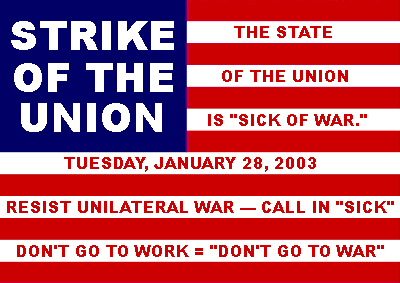
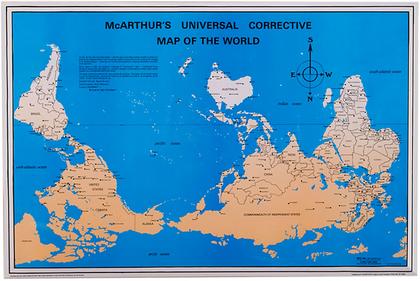
With W spending the next few days learning his lines for the State of the Union speech Tuesday, I thought we should tie the two thoughts together. I submit, for your consideration, the above Strike of the Union flag.
If you agree that the seeming inevitability of this war is sickening, copy the Strike of the Union flag from this page and email it to your friends or post it on your own blog. And stay home on Tuesday. Live your life instead of the administration's agenda.
Resist the scare tactics of meaningless terror alerts and unconscionable vagueness about the real threats to this country. The administration has already said that anyone who disagrees with it is a traitor. Apparently we aren't disagreeing forcefully enough.
The lousy Bush economy has made a dent in all our lives. Let's return the favor by not working on Tuesday and simultaneously showing our profound disapproval of his unilateral war plans.
PAST WINNERS: Bo Derek, Ann Coulter [shown], Laura Ingraham, Shannen Doherty, Patricia Heaton, Debbie Schlussel, Kim Alexis, Patriot Girl, Ellie Michaels, Betsy Hart, Lori Waters, Katherine Harris, Sara Evans, Rachel Marsden, Kristen Andersen, Kim Seraphin, Rachel Alexander, Michelle Malkin, Lauren Bush*, Debbie Brannigan, Ashley Judd, Cheryl Ladd, Emma Caulfield, Emily Pataki, Carol Gargaro, Kathy Ireland, Heather Locklear, Martina McBride, Condi Rice, Monica Crowley, India Allen, and Darcy Olsen.
This site is a treasure trove of tears-in-your-eyes hilarity. Physicists take note: there really is a parallel universe, and it's the Republican culture, or lack thereof.
WASHINGTON, Jan. 22 — The Bush administration plans to allow religious groups for the first time to use federal housing money to help build centers where religious worship is held, as long as part of the building is also used for social services.
The policy shift, which was made in a rule that the Department of Housing and Urban Development proposed this month, significantly expands the administration's contentious religion-based initiative.
The White House says it wants to end discrimination against religious groups. Opponents say the policy breaches the separation of church and state.
Current regulations generally prohibit religious groups from using federal housing and community development grants, which totaled $7.7 billion last year, to build or rehabilitate structures. The new rules, still subject to final approval by housing officials, allow the use of federal aid to acquire, rehabilitate or build centers used for religious and specifically approved nonreligious activities, so long as no federal money is used for the religious section.
A church could erect a building using federal money to create a shelter for the homeless in one part and private money to create a sanctuary in another part, officials said. A synagogue could use a grant to rehabilitate part of its building for a counseling center for AIDS patients or the poor. A Muslim group could apply for federal money to upgrade the lighting and equipment in a room in its mosque to allow it to be used as an counseling center for single parents.
[…]
"This is probably the most clearly unconstitutional aspect of the White House's faith-based initiative that we've seen up to this point," said Christopher Anders, legislative counsel for the American Civil Liberties Union. "What this does is take federal money that is serving the neediest of the needy in our society and diverts it to the bricks-and-mortar construction of churches and sanctuaries and other places of worship."
[…]
The public has until March 7 to comment before the department is scheduled to issue its final approval.
Theoretically, Saudis could set up a mosque in Florida with a federally-funded flight school and counseling center attached to it. Imagine the convenience!
And again, you gotta go back to the fact, it's not everybody's ballot that was voided. The blacker the ballot, the higher the chances it will not be counted, and that was the evil of it. That's the modern way: Use computers and mechanisms to steal elections, and if you know the race of a voter, you know the color of their vote.
DETROIT, Jan. 20 — The Bush administration's economic plan would increase by 50 percent or more the deductions that small-business owners can take right away on the biggest sport utility vehicles and pickups.
The plan would mean small businesses could immediately deduct the entire price of S.U.V.'s like the Hummer H2, the Lincoln Navigator and the Toyota Land Cruiser, even if the vehicles were loaded with every available option. Or a business owner, taking full advantage, could buy a BMW X5 sport utility vehicle for a few hundred dollars more than a Pontiac Bonneville sedan, after the immediate tax deductions were factored in.
Tax experts and environmentalists say the plan would provide incentives for businesses to choose the biggest gas-guzzling trucks because it takes several years to depreciate the cost of passenger cars and smaller sport utility vehicles.
Conservation appears not to be today's theme. Neither is rationality.
Gary also provides other parrot letters (besides the most recent "demonstrating genuine leadership" stimulus package roboletter) to show how widespread the practice is.
The next logical Googlfication would be to identify and expose the individual frauds and miscreants themselves. For example, as Gary demonstrates, Hawaiian Dirk M. Maurins wrote (I mean, didn't write) not one but two fake letters. This little party apparatchik works at a place called Select Technical Staffing and is a member of the Association of Information Technology Professionals, Honolulu Chapter. Google "Dirk M. Maurins" yourself if you don't believe me.
If we can't stop the astroturfers (and the co-dependent lazy-ass editors who enable them), we can at least shame them for being such mindless robots in public places.
That's when you should remember Linda McDougal, who was the recipient of an unneeded double mastectomy:
Dr. Daniel Foley, medical director of United Hospital, told a local television station on Friday that the hospital had made changes to ensure that "this kind of mix-up would never happen again."
In other words, "Gosh, we're sorry."
Now imagine that Linda McDougal is your mother, or your wife, or your daughter, or you.
The White House plan proposes a maximum of $125,000 per surgically removed healthy breast of Linda McDougal's.
Besides its inhumane favoritism of the interests of doctors and hospitals over those of patients, this disastrous plan would exacerbate the medical liability crisis by removing economic accountability — a pet Republican catchphrase — from medical practice.
We all need to stop thinking in terms of the spoon-fed soundbites emanating from the White House, and think more in terms of actual lives being affected by policy. Or, rather, actual lives being permanently damaged by poor policy.
Postscript #1: There are many excellent posts on tort reform and medical liability at The Bloviator.
Postscript #2: Dwight Meredith at PLA articulates this issue in useful and comparative detail, and even suggests a new cap.
Unprecedented examines the aftermath in Florida after the 2000 Presidential election. Long-time readers of this site won’t find anything surprising in the film. However, most Americans don’t know about the thousands of mostly African-American voters whose voting rights were taken away in the phony felony purge by Katherine Harris and Jeb Bush; I can think of no other way to honor Dr. King than to buy the video.
And also to remember how the stupendously underachieving W got into Yale ahead of plenty of more deserving African-Americans whose only lack of achievement was in not coming from a whiter, richer, more socially lubricated family.
Look at the grammar in this published letter (from the lazy-ass editors of The Boston Globe):
When it comes to the economy, President Bush has demonstrating genuine leadership. The growth package he has proposed takes us in the right direction...
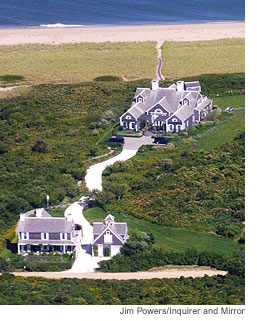
One has seen the value of his island getaway quadruple since he built it. Another just sold his Aspen "cottage" for $10 million -- more than five times what he paid for it. And then there's former Tyco CEO Dennis Kozlowski, who may have lost his $16.8 million Manhattan co-op, but can still relax at his $5.7 million Nantucket estate [shown] -- or at homes in Boca Raton, Fla., and Beaver Creek, Colo.
Judging by the headlines, 2002 was a pretty bad year for America's chief executive officers, from the debacles of WorldCom and Enron to a host of embarrassing Chapter 11 filings. But judging by the current values of their homes, many of them have made some pretty good investments. Indeed, while ordinary Americans watched their home prices grow an average 6% in 2002, some of the more newsworthy CEOs did far better, with the home values of a handful growing more than 40% in 12 months.
What's the word for hatred of the rich? Or, rather, hatred of the abusive behavior of the rich toward the people that help enrich them? Email me suggestions.
Software giant Microsoft Corp., finally bowing to mounting pressure to return some of its huge cash hoard to investors, said it will begin paying a regular annual dividend to shareholders.
The surprise move, coming on the heels of President Bush's recent proposal to eliminate the federal tax on dividends, represents a big shift for the nation's most valuable high-tech company, which for 17 years has spurned the idea of a dividend in favor of plowing cash back into product research and development.
[...]
Top Microsoft executives, however, could see their income rise soon because of the newly declared dividend. Chairman Bill Gates, who held 621.7 million shares of Microsoft as of Sept. 9, or 11.6% of the company, could expect an annual dividend check of $99.48 million. For chief executive Steve Ballmer, who holds 235.5 million shares, dividends would amount to $37.68 million.
Those attractive piles of $99 million and $37 million (try to picture them, in small denominations, in your living room) are tax-free under the ultra-generous Bush plan.
Generous to a very select few, that is. Even a truck driver with a winning Powerball lottery ticket has to pay substantial taxes on similar amounts of money. Why? He didn't work for it! It's unearned!
Why do these two already-rich men — and others like them — deserve to pay not one dime of taxes on an unearned sum of $136 million? Is it just for being alive at the same time as a dim-witted (or evil, take your pick) president?
The Office also collaborates with the following "Participating Agencies" in the city of Chicago, where I live so very anonymously:
Federal: Bureau of Alcohol, Tobacco and Firearms, Drug Enforcement Administration, Federal Bureau of Investigation, Immigration and Naturalization Service, Internal Revenue Service, United States Attorney's Office, United States Customs Service, United States Marshals Service, United States Postal Inspection Service, Housing and Urban Development-Office of the Inspector General
State: Illinois State Police, Office of the Illinois Attorney General, Illinois National Guard
Local: Cook County Forest Preserve Police, Cook County Sheriff's Department, Cook County State's Attorney, Grundy County Sheriff's Department, Kendall County Sheriff's Department, Will County Sheriff's Department, Bartlett Police Department, Blue Island Police Department, Bolingbrook Police Department, Braidwood Police Department, Calumet City Police Department, Chicago Police Department, Chicago Heights Police Department, Elk Grove Village Police Department, Joliet Police Department, Lockport Police Department, Matteson Police Department, McCook Police Department, Oak Forest Police Department, Oswego Police Department, Palatine Police Department, Plano Police Department, Railroad Police, Riverdale Police Department, University of Illinois at Chicago Police Department, Waukegan Police Department, Yorkville Police Department
The tall man asked a second time for my cooperation, but I refused and politely showed him the door.
With the selective but extremely potent fragments of personal information they requested, they could easily make the short leap to criminal record, political party affiliations, DMV reports, citizenship status, credit report, legal activity, insurance history, medical records, and so on. Basically anything they want to make nearly any case against anyone.
Saying "yes" to "Have you ever, even once, used marijuana or hashish?" is tantamount to a written, government recorded pre-confession. Whatever public health research benefit might result from the study is dwarfed by the individual risk of personal damage by a growing bureaucracy that, beyond becoming antagonistic to its own citizens as a matter of policy, is totally out of control in practice. They won't know which fifteen Saudi nationals are in American flight schools, but they'll know you smoke pot. J. Edgar Hoover is grinning ear-to-ear as he molders in his crypt.
My wife was upset because she wanted the thirty bucks, which would not have bought even the left foot of the shoes she currently covets. But then I wondered, Who the hell is footing the bill to extract these drug use pre-confessions from an unsuspecting public?
The answer is: you are.**
Is it me, or is American life beginning to resemble Terry Gilliam's film Brazil more and more every day?
**International disclaimer: If you're an American reader and taxpayer, that is.
Last week I wrote about "cracker chic," the phenomenon of wealthy people building million-dollar houses that are intentionally distressed to look like poor people's homes.
This new cultural wrinkle, featuring residential design as a weapon of class warfare or at least class insult, has haunted me ever since. The passage below, from the originally quoted article, has literally kept me awake at night:
The desire to get "back to the basics" is what drew Fort Worth native Michelle Coslik and her husband Steve to a two-story, $1 million vacation home in WaterColor, which is being developed by the homebuilding subsidiary of Jacksonville-based St. Joe Co.
Ms. Coslik's home features 1,000 square feet of screened-in porch. The screen door is made of mahogany and fitted with hinges that mute the slam into a sort of soft thud that one WaterColor marketing executive describes as "the sound of growing up in the South." The cost of the door, including handle, is $700.
Ms. Coslik, 36, isn't using her porch to escape the heat as the early settlers once did. She has air conditioning for that. For her, the porch is a place to meditate and practice Yoga. "When I think cracker," she says, "I think of getting back to the essence and away from material aspects of life."
It is the image of Michelle Coslik, meditating and practicing her yoga on her enormous screen porch while thinking sublime thoughts about southern poor folk, that resonates so strongly for me as a symbol of what has gone wrong with our country. It has bothered me ever since because I can visualize her blithe ignorance so clearly.
And so I asked myself: Who is Michelle Coslik?
We know from the article that she is the 36-year-old wife of Steve Coslik. They live in Fort Worth. They have a million-dollar vacation home in WaterColor, a development 30 miles outside Panama City in the Florida Panhandle, where developers are going beyond architecture to offer the "cracker experience." She wants to "get back to basics." She had a $700 door custom-made to evoke "the sound of growing up in the South." She has air conditioning, but prefers to practice yoga on her screened-in cracker porch.
But I needed to know more. What are Steve and Michelle Coslik like? Where did their money come from? What do they believe in? Michelle Coslik, the meditating wife on her cracker porch, my perfect symbol of ignorant vanity, needed to be fleshed out in my imagination. And so I turned as I would for any potential object of my curiosity to the source: Google.
Cracker husband Steve Coslik is the Chairman of The Woodmont Company, a nationwide real estate services firm, where he handled acquisition, negotiation and development of 11.6 million square feet of retail, office and industrial space. The 51-year-old owner of the $1 million cracker vacation home also enjoys running (#124) and damaging wetlands.
She and husband Steve have given at least $10,000 to Fort Worth's Bruce Wood Dance Company. In my mind's eye, I can see Michelle Coslik practicing her dance stretches on her cracker porch. But, alas, she is 36! Perhaps young enough to serve as the trophy wife of a real estate magnate fifteen years her senior, but too old for an aspiring dancer. If only she were younger and more limber — like the poor but chic (and doubtlessly photogenic) cracker wife she wishes she could be.
She and husband Steve are on the advisory board of the Sedona Intensive program, a self-described "Personal Growth Alternative Therapy," that allows its adherents to "finally break the grasp of addictions, compulsive behavior, and egocentric patterns. Resolve relationship conflicts."
Is that all the Sedona Initiative does? No, no, no. "To really hear God we need to clear away the static which clouds the channels God often uses to speak to us. After you clear away toxic blocks to the Creator, we will teach you to understand The New Language."
The New Language? Is that Orwell-speak for communication among God-sanctioned class warriors? Well, yes:
What the five days, or more, in Sedona will ultimately do for you is teach you The New Language — how to listen to God and get answers to your prayers, to know that you are on the right track even when plagued by worry, doubt and uncertainty.
Many years ago, after many personal struggles, I believe I began to hear God and experience His presence in the world around me, and my own life improved tremendously. I believe that God wants all of us to have a tie-in to Him. Knowing The New Language makes that possible.
But first, you must put the plug in the jug. Get clean. Get help with sexual addiction. Face compulsive/obsessive disorders. Surrender and clear your control dramas.
Clearing your control dramas evidently means submitting to guru Albert Clayton Gaulden, mentor to James Redfield of The Celestine Prophesy fame.
Gaulden refers to his methodology as "clearing," which is not to be confused with the term used by Scientology.
As a recovering alcoholic, sober for more than 22 years, he uses his honed intuition and Jungian archetypes to speed the plow of the process. Fearless and tough, Gaulden steers the prodigals who come to Sedona toward a powerful and personal relationship with the God within.
The Sedona Intensive, prodigal Michelle Coslik's faith-based luxury spa, has many delightful features:
On a typical day, you will attend a 12-step meeting, consult with a spiritual psychologist, relax with a hot lava rock massage, take a yoga class and receive a Network Chiropractic adjustment.
In addition you will breathe through core issues with a transformational breath worker, unwind in a Jacuzzi or steam room after meditation hikes through majestic Red Rock country.
When her muscles tense from stressful meetings with her cracker interior designer, Michelle likes to relax with a hot lava rock massage. Yoga is Michelle's favorite way of exploring the God within. If she inhales too much faux cracker dust into her lungs, her transformational breath worker is just a quick jet ride away. The Jacuzzi helps wash away the expensive cracker dust from her delicate pores. The "spiritual psychologist" must be useful in helping to calm the troubled seas of Michelle's soul, even in the comfort of her cracker home.
After my exhausting research, I feel that I now know Michelle Coslik much better. And, believe me, it was worth the time. Using my honed intuition and Jungian archetypes, I am beginning to understand her. I can even detect the faint silhouette of the God within her. Given the burden of her wealth, I can almost sympathize with the shallow, hateful disrespect she feels for poor people — the cracker lifestyle she finds so chic.
Speaking of "control dramas," we're engaged in one right now. WaterColor, the cracker chic development of vacation residences for millionaires who aim to make poverty more picturesque, is one of the enclaves of faith-based and wealth-based insanity that now characterizes the USA. The Cosliks represent the kind of brain-poor but asset-rich people the Republican "stimulus package" is designed to benefit.
Cracker chic is class warfare, and the blissful, ignorant and wealthy Michelle and Steve Coslik are the enemy.
Atrios of Eschaton points out that the same letter praising W's self-stimulus package and sporting the phrase "demonstrating genuine leadership" (a poll-friendly subliminable message) is simultaneously appearing under different names in newspapers nationwide. The practice of such unreality is called astroturfing.
You can google the phrase for a current look at which lazy-ass editors have been hoodwinked by propagandist drones most recently.
UPDATE: One day later I wrote more on this topic here.
America has entered one of its periods of historical madness, but this is the worst I can remember: worse than McCarthyism, worse than the Bay of Pigs and in the long term potentially more disastrous than the Vietnam War.
The reaction to 9/11 is beyond anything Osama bin Laden could have hoped for in his nastiest dreams. As in McCarthy times, the freedoms that have made America the envy of the world are being systematically eroded.
[...]
The imminent war was planned years before bin Laden struck, but it was he who made it possible. Without bin Laden, the Bush junta would still be trying to explain such tricky matters as how it came to be elected in the first place; Enron; its shameless favouring of the already-too-rich; its reckless disregard for the world’s poor, the ecology and a raft of unilaterally abrogated international treaties. They might also have to be telling us why they support Israel in its continuing disregard for UN resolutions.
[...]
Those who are not with Mr Bush are against him. Worse, they are with the enemy. Which is odd, because I’m dead against Bush, but I would love to see Saddam’s downfall — just not on Bush’s terms and not by his methods. And not under the banner of such outrageous hypocrisy.
Ouch. Blair doesn't come out smelling much better, either. (Via the indispensable TBOGG.)
Josh Marshall of Talking Points Memo has written a scathing point-by-point catalog of the incompetence of Dick Cheney, brought on by his mindset of "cartel-capitalist" arrogance.
"If there were any justice or logic in this administration as to who should or shouldn't keep their job, there'd be another high-ranking official in line for one of those awkward [resignation-demanding] conversations: Dick Cheney."
"...the evolution of White House Iraq policy might be described fairly as a slow process of overruling Dick Cheney."
"Not since the Whiz Kids of the Kennedy-Johnson years has Washington been led by men of such insular self-assurance. Their hierarchical, old economy style of management couldn't be more different from the loose, non-hierarchical style of, say, high-tech corpor-ations or the Clinton White House, with all their open debate, concern with the interests of "stake-holders," manic focus on pleasing customers (or voters), and constant reassessment of plans and principles. The latter style, while often sloppy and seemingly juvenile, tends to produce pretty smart policy. The former style, while appearing so adult and competent, often produces stupid policy."
"...Cheney's reputation as the steady hand at the helm of the Bush administration--the CEO to Bush's chairman--is so potent as to blind Beltway commentators to the examples of vice presidential incompetence accumulating, literally, under their noses."
What a treat! It's all here: Paul O'Neill, John Snow, Condoleeza Rice's gentle scolding, the energy task force, sidestepping the Hart-Rudman antiterrorism commission, the unilateral Iraq war plans, tacit approval of corporate malfeasance, his insular background, and his colossal lack of judgment. Quite a portrait of worthlessness, which, at the vice presidential level, amounts to massive acts of national damage.
AL FRANKEN: People on the left -- liberals -- don't want to hear simplistic demagoguery. They want to hear information. This is why NPR is accused of being liberal -- because liberals [LAUGHS] listen to it, [LAUGHS] and liberals listen to it because you get a BBC report about what's going on in Afghanistan. And they don't want to hear Rush Limbaugh going like [IMITATING] "There was not one iota-- of memorializing at the Wellstone memorial, my friends." [LAUGHTER]
BOB GARFIELD: Okay, so sometimes he's a little skimpy on the facts; that's true.
AL FRANKEN: Oh -- sometimes?! [BOTH SPEAK AT ONCE]
BOB GARFIELD: Are you suggesting that it - were there a liberal counterpart to Rush Limbaugh who used the same techniques, they couldn't make it because the liberal mind, by its very nature, simply will not countenance such distortions and, and sophistry and trickery?
AL FRANKEN: You put it very well. I really believe that.
Texas Attorney General Greg Abbott blasted Enron's bankruptcy attorneys Monday, saying they are "lining their pockets" with fees at the expense of taxpayers, former employees and investors.
At the present rate of spending, Abbott said, the money spent on lawyers and accountants sorting through Enron's remains could approach $1 billion. He said the company should consider an immediate liquidation.
Since going into bankruptcy 13 months ago, Enron has spent more than $300 million on professional fees -- easily a record -- and is burning through $25 million a month. The situation could linger for months, even years. [...]
The meager prospect for a meaningful reorganization appears to be falling apart, rapidly burning money as it does so, some creditors say.
The fee total has already surpassed a widely cited record, $200 million spent in the early 1990s by the Luxembourg-based bankruptcy of the Saudi Arabian Bank of Credit and Commerce International, or BCCI.
And although WorldCom's bankruptcy is larger, its financial problems are far more straightforward, and thus its professional-fee expenses are much smaller than Enron's.
The primary firm representing both companies in bankruptcy is New York-based Weil Gotshal & Manges. Early on, its monthly billings to Enron were running more than $6 million a month. In comparable stages of the WorldCom case, the firm billed $1.5 million to $2 million a month.
Can't you just smell the money burning in Texas? And it's always someone else's money. Not the Bushes'. Not the Lays'. Not the Skillings'.
Lewis Lapham of Harper's said in 2001:
How else to describe the new administration's legislative agenda — elimination of the inheritance tax, revision of the bankruptcy laws, the repeal of safety regulations in the workplace, easing of restriction on monopoly, etc. — except as an act of class warfare? Not the aggression that Karl Marx and maybe Ralph Nader had in mind, not the angry poor sacking the mansions of the rich, but the aggrieved rich burning down the huts of the presumptuous and troublemaking poor.
"Class warfare"? Where have we heard that phrase before?
The more the Enron crooks (and their esteemed law firm) drag this out, the less monetary retribution will be available to the people they financially molested.
We are now in a second Gilded Age. Instead of taking steps that would strengthen our democracy, we're heading backward to the wealth inequalities of a century ago. We need to preserve the estate tax in states and at the federal level for exactly the reason it is under assault. In a democracy, we should be offended when the power of concentrated wealth brazenly attempts to shape the terms of policy debate and dictate the rules of our society.
Coming from a man who is asking for a tax on his own heirs — the richest family on earth — this logic is all the more striking in its clarity. He is insisting that rational taxation of family wealth is better than the damage to democracy that would otherwise occur.
These ideas are not unique to technology Democrats or their dads, either. Kevin Phillips, the economic historian whose own background is Republican, argues in his excellent book Wealth and Democracy:
For example, by 2000 the United States could be said to have a plutocracy, when back in 1990 the resemblance to the previous plutocracy of the Gilded Age had not yet fully matured. Compared with 1990, America's top millennial fortunes were three or four times bigger, reflecting the high-powered convergence of innovation, speculation, and mania in finance and technology. Moreover, the essence of plutocracy, fulfilled by 2000, has been the determination and ability of wealth to reach beyond its own realm of money and control politics and government as well. In America, explains political scientist Samuel Huntington, "money becomes evil not when it is used to buy goods but when it is used to buy power... economic inequalities become evil when they are translated into political inequalities."
If there is a running theme to the political content of this blog, it is best expressed by that quotation. We don't hate wealth or power. We hate the abuses of wealth and power.
Bill Gates Senior's article is heroic because it is ethical in an unethical time. He demands what is right — even when his family has so much to lose. By recognizing the greater good of American democracy, even for the wealthy, he reveals a backbone of political and economic morality that is totally absent from the White House.
The Chicago Tribune, which owns the Los Angeles Times, reports on the antiwar protests there:
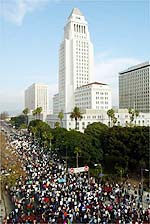
Thousands of people protesting a looming U.S.-led war against Iraq marched through downtown Los Angeles on Saturday, with many chanting, "We want peace!"
According to police, the crowd numbered between 5,000 and 7,000. Many wore their opinions, such as "No War" or "Don't Cut Medicare for Bombs and Missiles," on T-shirts, buttons and baseball caps. Organizers estimated the crowd at 15,000.... [...]
At the Federal Building, rock singers, poets, activists and actor Martin Sheen, star of the NBC series "The West Wing," denounced war over loudspeakers. Rep. Maxine Waters (D-Los Angeles) and Los Angeles Urban League President John Mack also took part in the event, which was a precursor to a series of upcoming demonstrations set to take place in San Francisco and Washington, D.C., on Saturday.
I voted for President Bartlett, and all I got was this lousy Supreme Court coup.
NEW YORK, Jan 12 (Reuters) - Even before U.S. President George Bush this month unveiled his tax cut plan that could eliminate dividend taxes for investors, Merrill Lynch's chief U.S. strategist picked 18 dividend-paying companies he said could offer investors safety and income, according to Barron's magazine.
[...]
Bernstein's picks include Merck & Co. Inc. (NYSE:MRK), Procter & Gamble Co. (NYSE:PG), Abbott Laboratories Inc. (NYSE:ABT), Gillette Co. (NYSE:G), 3M Co. (NYSE:MMM) and BellSouth Corp. (NYSE:BLS).
"Let Us Praise Steady Dividends," the original article in Barron's (subscription only – link) adds to the above information with a little-known aspect of the "stimulus package":
Of course, there will be other ways to benefit from a dividend tax cut. One lower-profile area set to benefit is the market for perpetual preferred stock. Those shares pay a dividend (although they typically give the issuer the option not to make the dividend payment), and they do not mature.
There is about $24 billion of perpetual preferred stock outstanding, estimates William Scapell, a director at Merrill Lynch. That's about 15% of the larger preferred market, which also includes trust preferreds and preferreds issued by real estate investment trusts. Those two, however, wouldn't benefit from the Bush plan because their issuers have already received a tax benefit.
Unfortunately, many of the more appealing preferred issues have rallied sharply in anticipation of the tax change. For example, Alabama Power, a unit of Southern Co., has perpetual preferred that pays a 5.2% dividend. On December 18, the yield to the 2008 call date was 11.3% and now it stands at 5.96%.
Likewise, Citigroup's perpetual preferred, with its 6.365% dividend, once offered investors a yield of 9.26% but now yields 5.53% to its 2007 call. But if Bush's tax cuts and Bernstein's predictions of a more risk adverse world come to pass, even low dividends could command the market's attention.
How much does W love the rich? Giving them $674 billion is a very public display of affection.
Say farewell to growth stocks for a while. Kiss computer technology, wireless, biotech and nanotech goodbye.
The "stimulus package" is already shaping up to be a scandal analogous to Daddy's S&L debacle, which was quite generous to W's competence-free brother Neil Bush.
Consider the Linda and Ken Lay Family Foundation of Houston. Mr. Lay was chairman of Enron, and 90 percent of the foundation assets, valued at $52.2 million at the end of 2000, were in Enron stock.
The foundation could comfortably afford a full-time director, Heather H. Herrold, whose salary was $83,684. Mr. Lay got a tax deduction based on the value of Enron stock when he gave it to the foundation.
Enron went bankrupt amid scandal in late 2001, and the foundation recently reported that its assets had fallen to $2.4 million, forcing it to postpone many pledges. The Internal Revenue Service may not, however, retroactively revoke part of Mr. Lay's deduction to reflect the decline in the foundation's value.
Bear Left!, in an excellent overview, reports that Lay donated over $20.5 million in stock in 1999 and 2000. Tax deductions are only useful when applied against income, which suggests that Ken Lay had substantial income to protect in 2000. Since we know that his insider trades prior to the Enron bankruptcy amounted to roughly $70 million, this means that not only did he lie to analysts and shareholders while he was selling his shares, but, adding injury to insult, he also underpaid taxes on his insider plunder.
Let's review:
Ken Lay created a foundation out of Enron stock worth about $52.2 million in 2000 — which he was simultaneously selling to the tune of about $70 million.
Ken Lay did this while urging stock analysts and employees to invest in the stock for investment growth and 401(k) participation.
Ken Lay took a multimillion tax deduction for the donation of the stock.
The foundation recently reported that its assets had fallen to $2.4 million.
The foundation is reneging on its pledges to the charitable causes it would supposedly help.
The IRS "may not" retroactively revoke part of the deduction to reflect the decline in the foundation's value.
Ken "Kenny Boy" and Linda "Jus' Stuff" Lay received the full benefit of a multimillion tax deduction on now near-worthless stock used to fund a charity foundation which has helped no one. No one but them.
Meanwhile, close friend Bush's "stimulus package," half of which is tax elimination on dividend (i.e., unearned) income, benefits the wealthy who don't need help, already have figured out all the loopholes, and are playing the existing shell game of insider trades, charitable foundations and tax deductions in their favor.